
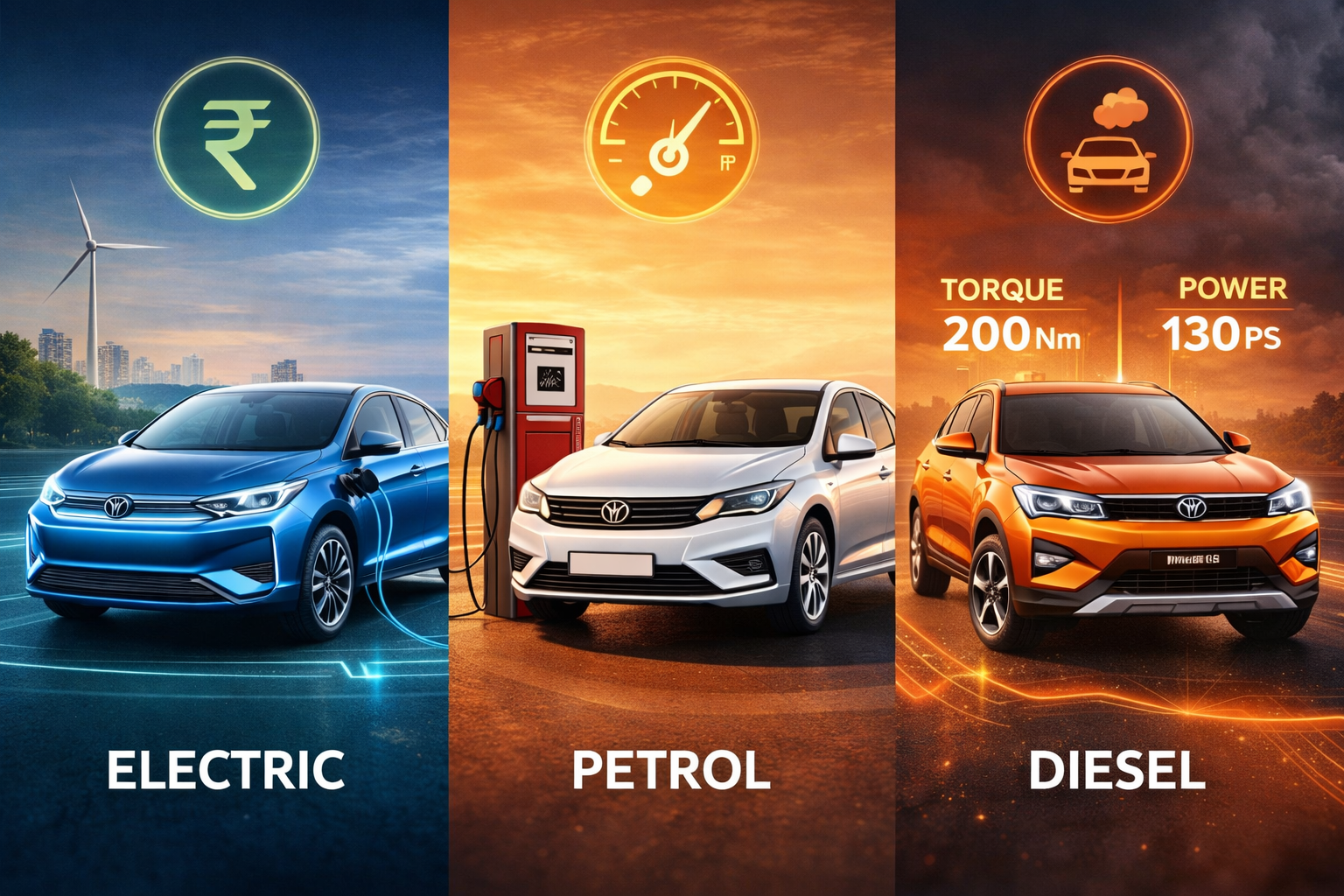

Choosing the right car nowadays goes beyond just brand or appearance. To determine which choice provides superior value, performance, and long-term advantages, buyers are increasingly evaluating EV vs Petrol vs Diesel.
Due to an increase in fuel prices, stricter emissions regulations, and growing environmental awareness, comparisons of this type are now more valid. As each type offers both advantages and disadvantages, the “best” choice will depend on how the vehicle is going to be used, the consumer’s budget, and driving style.
Understanding Electric Vehicles (EVs)
Electric vehicles powered by batteries define electric cars. Lower operating expenses and government incentives help them become increasingly well known for zero tailpipe emissions.
Cost of Ownership for EVs
Generally speaking, electric vehicles cost more than diesel or petrol vehicles. Over time, though, the whole ownership cost usually offsets itself. Because of fewer moving components, electric vehicles need little upkeep. Moreover, electricity is far less expensive than traditional fuels. Long-term savings result from fewer wear-and-tear components, no engine oil changes, and lower service requirements.
Performance and Driving Experience
Instant torque provides immediate and smooth acceleration. EVs have no vibration, so they are very suitable for urban driving. However, the availability of charging infrastructure is still an issue for those beyond the city or on long-distance trips.
Environmental Impact
From an emissions perspective, electric cars are the cleanest choice. Though battery manufacture has an ecological impact, total lifetime emissions are often less than those of gasoline or diesel vehicles—especially when charged with renewable energy.
Petrol Cars: Balanced and Familiar
Because of their low price and broad fuel availability, petrol cars continue to be the most often used choice in many countries.
Purchase Price and Running Costs
Usually, the initial purchase price of petrol vehicles is lowest. The servicing is easy; maintenance costs are modest. However, fuel costs for high-mileage users can add up as petrol prices often fluctuate.
Performance and Usability
Compared to diesel engines, petrol engines are popular for their smooth performance and less noise. They are perfect for short excursions, city commutes, and infrequent highway driving. For customers with less daily driving, petrol vehicles generally make practical sense.
Emissions and Legislation
Although petrol car emissions also have carbon emissions, the amounts of particulates and nitrogen oxides in diesel cars are lower compared to petrol cars. Although petrol engines are becoming cleaner with better emission norms, EVs are not so environmentally friendly.
Diesel Cars: Designed for Long-Distance Driving
Diesel vehicles have traditionally been favored for their fuel efficiency and torque-heavy performance.
Fuel Economy and Cost of Ownership
Diesel cars are ideal for long road trips due to their ability to sometimes go farther compared to petrol cars. Over time, higher acquisition costs due to higher maintenance costs and rising prices of diesel may negate the benefits.
Engine Performance
Powerful low-end torque from diesel engines helps with highway cruising and carrying heavy loads. This makes commercial users and regular travelers particularly fond of them.
Environmental Considerations
Compared to petrol cars, diesel engines release more particles and nitrogen oxides. Stricter emission standards imply that contemporary diesel vehicles are more complicated and expensive to maintain. Their future viability in metropolitan areas is increasingly doubtful.
EV vs Petrol vs Diesel: Running Costs Comparison
In most cases, EVs perform well in terms of running costs in comparison to EV versus petrol and Diesel. It is by far more expensive to fill a gasoline or diesel vehicle than an EV. Petrol cars are positioned in the center. Even cars with better mileage, like diesel cars, may end up being expensive due to the cost of fuel and maintenance.
EVs can also prove to be the most economical in the long run when it comes to the daily commuter. Annual consumption of less than 10,000 litres of petrol still makes automobiles with petrol engines affordable. Those with diesel engines, as well, suit high-mileage drivers despite higher maintenance.
Maintenance and Reliability Factors
EVs require minimal maintenance requirements due to a lack of clutches, gearboxes, and exhaust systems. This causes EVs to have the least maintenance needs. They are typically reliable and easy to maintain, but petrol cars need frequent maintenance. Usually, with turbochargers and emission control systems, diesel cars tend to have greater repair costs as they age.
Which Option Is Better for City Driving?
For metropolitan applications, electric vehicles and gasoline vehicles do best. Electric vehicles’ capabilities for zero emissions, quiet operation, and low operating costs give them unique characteristics that distinguish them from other types of vehicles. Diesel engines, while being able to handle both stop-and-go driving as well as short trips; however, would also be capable of handling short distances.
What Is Better on Highways and Long-Distance Travel?
The diesel cars remain the popular choice in long-range distance highway driving because they are reliable and can keep their performance intact even during long durations of time. There are petrol cars, which are equally good but can be more expensive because of the high prices at the gas tank.
Although electric vehicles have come a long way, there are major constraints concerning the time taken to charge an electric vehicle and the absence of sufficient charging stations for normal usage of long-range traveling.
Conclusion: EV vs Petrol vs Diesel- Which is superior?
There is one factor that is lacking in the EV vs Petrol vs Diesel argument. Electric vehicles are suitable for a consumer who is environmentally conscious, and also for the typical commuters who are seeking low running costs. Gasoline cars are cheap, easy to own, and flexible to use for light use. Diesel cars remain a dream for high-mileage drivers who drive long distances most of the time.
At the end of the day, the superior alternative depends on the driving habits, budget, the availability of charging networks or fueling, and long-term ownership goals. The knowledge of these factors will help consumers to make more informed future decisions.
FAQ
1. Which will be cost-effective in the long run?
It is known that electric vehicles have low operation and maintenance costs as compared to petrol/diesel vehicles.
2. Which type of car would be the most suitable one for the long-distance trip?
Long-distance highway driving is normally favored by the use of diesel-powered vehicles compared to gasoline-powered vehicles due to the high mileage they cover.
3. Which one is more environmentally friendly?
Electric vehicles do not produce any pollutants when they are on the road, as is the case with gasoline/diesel vehicles. They are therefore more preferable for the future.