
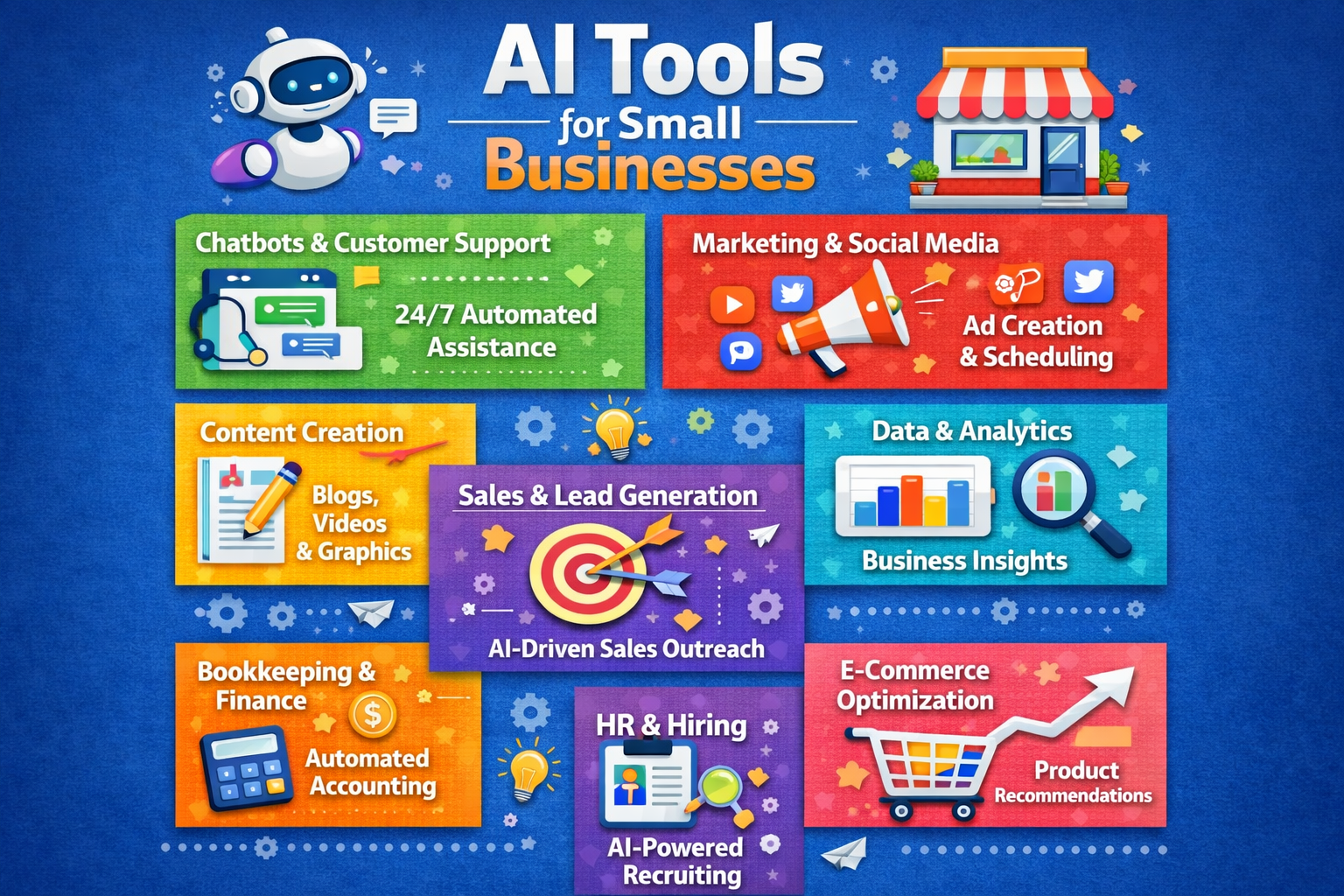

Artificial intelligence (AI) is now mainstream and hasn’t stopped advancing business. In fact, it’s gaining momentum. According to the latest Salesforce’s Small and Medium Business Trends Report, 75% of SMBs have invested in AI in some capacity. And one-third have implemented it fully in their businesses. AI is now a portal to connect to customers, keeping them interested in your business.
But are you ready for it? If not, we’ve got you. We break down AI tools for small businesses, from benefits to challenges and how to choose the right tech stack.
What is AI for Small Business?
AI for small business is just the application of artificial intelligence technology to remedial work that consumes time and resources. The AI technology is meant to imitate some parts of human intelligence, particularly information processing and decision-making.
Small to medium-sized businesses (SMBs) can apply AI technology to automate different tasks, build AI agents such as Agent force to enhance customer service through advanced chatbots, customize marketing campaigns using generative AI (Gen AI), and optimize business processes.
Although AI applications for SMBs are normally scaled down compared to larger corporations, they can still make a huge difference. For example, with the right customer relationship management (CRM) software, you can set up a free chatbot to answer customer inquiries.
Small businesses often have a small IT department or no IT department at all. AI-powered features such as process and software monitoring can help minimize IT problems without increasing complexity. AI can help small teams by helping with smaller tasks and making their overall work more efficient.
AI Applications for your Small Business
More and more companies are turning to AI-powered tools to help them work smarter. For small businesses, AI can help you maximize your resources. AI’s powers can give small businesses more time to focus on important projects and eliminate make-work.
Sales and marketing
Sales strategy and marketing plan development are essential to the success of any organization, regardless of its size. As the majority of companies operate within limited budgets and timelines, staying current with trends in both areas (e.g., sales & marketing) can be very difficult.
By utilizing generative artificial intelligence technologies within these disciplines, businesses will increase their ability to conduct research at a faster pace, as well as create concise summaries of lengthy written material about potential customers and target markets for greater efficiency when developing new customer relationships.
With your Workspace account, you can use Gemini to help with research, content creation, and data organization so that you can find the time to create great messaging. Gemini provides help with creating presentations and tailoring your pitch to fit an individual customer. It’s often difficult to determine whether or not your sales & marketing efforts are effective, but you don’t need to be an expert at using spreadsheets. Thanks to Gemini, you can find relevant information without needing to jump through any hoops.
Creative writing
For smaller teams with many competing priorities, generative AI makes it easy to overcome writer’s block and quickly generate a first draft or repurpose existing content for a new format. Gemini can assist you in writing emails, branded content, social media posts, and much more, helping you save time.
To use Gemini, you can use the function “Help me write” and add your company’s brand voice, target audience, and other relevant information to assist Gemini in Docs in generating an initial draft. After that, you can review and add your creative touches to get your message out into the world.
Customer service
Small businesses use exceptional customer service to create a unique Brand identity. To automate many processes, GPT can assist with responding to customers, sending customer support emails, creating a call log, etc. Creating customer-driven touchpoints using your customer data will help you provide a service that will enhance those touchpoints.
Operational efficiency
When developing a new product or project, you will have a way to stay on track as you work with Gemini to help you stay on target. Celebrate. By using Help me organise and/or Gemini in Sheets, you have the ability to create checklists, project trackers, etc., in about 1 second or less. Using the collaborative capabilities of Google Workspace, you can share those resources with your team and track the progress or completion of those resources, ensuring that you remain on target.
FAQ
1. What are No-AI tools?
No-AI tools are software and solutions that do not use artificial intelligence but instead use traditional approaches or simple automation to complete business tasks.
2. Why do small businesses avoid using Artificial Intelligence tools?
As AI tools are more expensive than traditional or non-AI technology and are also more complex and require specialized (or highly specialized) data, small businesses opt for “non-AI” tools because they are easy to use at a lower cost.
3. Do No-AI (non-AI) Tools offer effective methods for managing customers?
Absolutely; No-AI tools like Customer Relationship Management (CRM) programs can effectively manage customer data, customer interactions, and overall customer management without requiring the use of an Artificial Intelligence system do all of these things.
4. In what ways do non-AI tools help facilitate project management?
Non-AI project management software (like Trello and Asana, for example) provides teams an opportunity to collaborate, manage tasks, and assign project milestones, all of which occur in an organized manner while the team retains control over the process.
5. Are No-AI tools less expensive than AI tools?
Yes, in most cases, No-AI tools are less expensive to purchase and maintain. They are also easier to use and require less training than AI-based tools.
Conclusion
Small companies who incorporate AI technology could save time by automating processes and enhancing client services through better function of their competitors marketing techniques by using AI hardware and/or software, leading to downsizing existing staff via automation, allowing small businesses to compete in the consumer driven digital economy while leveraging the power of artificial intelligence enabling them to be even more productive than before when they expand their use of AI technology.